



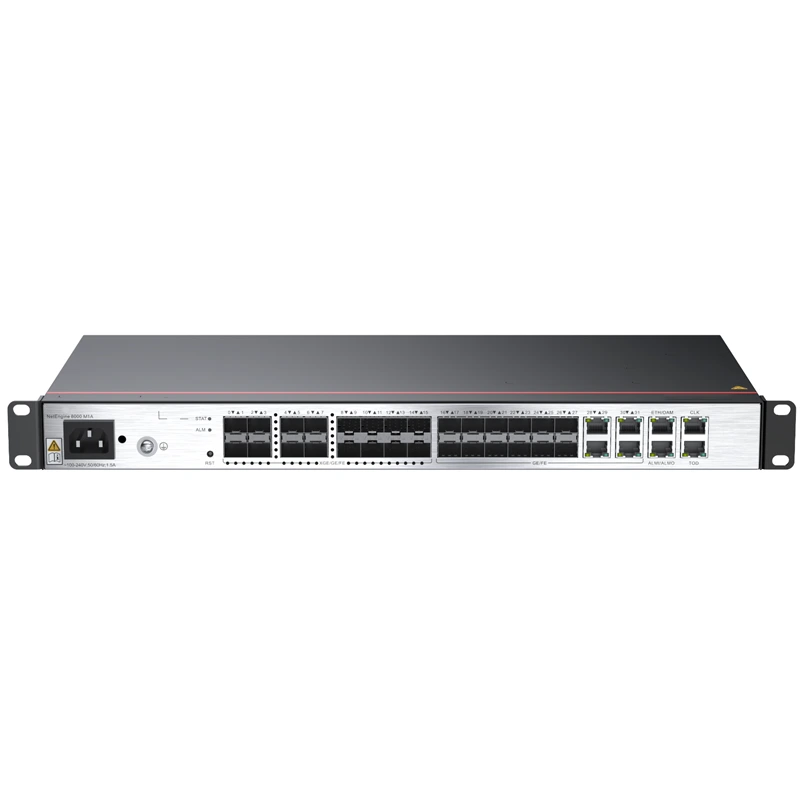
Enterprise Routers NetEngine 8000 M1A for 6*10GE+26*GE ,1*AC Power
● Model No.: NetEngine 8000 M1A
● Size: 44.5 mm x 442 mm x 220 mm
● Product positioning: Cloud edge/enterprise branch/metropolitan access layer universal business router, 1U height+220mm depth, can be installed in 300mm shallow cabinets, greatly saving data center space; Supports 10GE/GE optical and electrical hybrid ports, covering multi rate access.
● Place of Origin: Guangdong, China
● Core strengths: A176G/U ultra-high density, SRv6 end-to-end support, 1588v2 nanosecond clock, dual power redundancy (DC), -40 ℃ to 65 ℃ wide temperature range, Telemetry intelligent operation and maintenance.
● Warranty: 1years
● MOQ: 1 pieces
Application scenarios
1. Government industry wide area network access/aggregation node: This is one of its most core application scenarios. In Huawei's Xinghui Fusion Government Wide Area Network solution, NetEngine 8000 M1A is explicitly designated as the core or aggregation router for grassroots government nodes such as cities/counties/townships. It supports SRv6 and FlexE network slicing, which can divide independent logical networks for various government departments (such as education, health, finance and taxation) on a physical network, achieving "one network for multiple uses and data sharing".
2. Large enterprise branch/park convergence access: It can serve as a convergence/access router for large enterprise city branches or independent parks, connecting to the enterprise headquarters through SRv6 or IPsec VPN upwards and converging multiple access switches within the branch downwards. Its 352 Gbps switching capacity and 72 Mpps forwarding performance are sufficient to carry full business traffic for medium-sized branches.
3. Traditional TDM service carrying and smooth evolution: This is its unique application scenario. According to official Huawei documents, the 8000 M1A can be applied to TDM (Time Division Multiplexing) service access for 2G base stations, E1/T1 dedicated line access for different parks/campuses/enterprises, and other scenarios. It can simulate traditional E1 circuits as packet packets, transparently transmit them over IP/MPLS networks, and achieve unified bearer of 2G/3G/fixed networks, helping operators or large enterprises smoothly evolve from traditional networks to packet networks.
4. Data center interconnection (DCI): It can be used as a convergence or access node for the interconnection of small and medium-sized data centers, support SRv6 intelligent routing, and build an elastic and flexible data center interconnection network.
5. Large campus network outlet: in super large enterprise parks, it can be used as an exit router to connect multiple wide area links (such as special lines and the Internet), and provide advanced security protection and intelligent routing functions
Core functional characteristics
- 1. IP/MPLS full stack and SRv6: Supports OSPFv3, IS-ISv6, BGP4+, MPLS L3VPN/VPLS; SRv6+EVPN enables one network with multiple services, simplified protocol stack, and 50ms fast switching; Compatible with VxLAN
- 2. High reliability and security: IP FRR/LDP FRR/TE FRR, BFD millisecond level detection; IPSec encryption( 0.98Gbps@1400 Byte protection, URPF anti source IP spoofing, ACL and management plane protection
- 3. Clock and multicast: 1588v2 (PTP)+G.8275.1, meeting the clock synchronization requirements of 5G base stations; IGMP v1/v2/v3、PIM-SM/SSM、NG-MVPN
- 4. Intelligent operation and maintenance: supports Telemetry streaming data collection and interfaces with Huawei NCE network cloud engine; NETCONF/YANG Automated Configuration, Zero Contact Deployment (ZTP)
Detailed description
| Item | Specification |
|---|---|
| Cabinet installation standards | ETSI (21-inch); IEC (19-inch); IMB (3U); F01M50 outdoor cabinet |
| Dimensions without packaging (H x W x D) [mm(in.)] | 44.5 mm x 442 mm x 220 mm (1.75 in. x 17.40 in. x 8.66 in.) |
| Dimensions with packaging (H x W x D) [mm(in.)] | 255 mm x 585 mm x 390 mm (10.04 in. x 23.03 in. x 15.35 in.) |
| Chassis height [U] | 1 U |
| Weight without packaging [kg(lb)] | 4.5 kg (9.92 lb) |
| Weight with packaging [kg(lb)] | 5.8 kg (12.79 lb) |
| Typical power consumption (with configuration) [W] | 74.7 W |
| Typical heat dissipation (with configuration) [BTU/hour] | 242.36 BTU/hour |
| MTBF [year] | 35.99 year |
| MTTR [hour] | 2 hour |
| Availability | 0.99999 |
| CPU | 4-core 1.4 GHz |
| Memory | 4 GB |
| Flash memory | 64 MB |
| Storage | 2 GB |
| Power supply mode | AC |
| Rated input voltage [V] | 110 V/220 V |
| Input voltage range [V] | 100 V to 240 V |
| Maximum input current [A] | 1.5 A |
| Rated output power [W] | 170 W |
| Maximum input cable size [mm²] | Standard C13 cable |
| Front-end circuit breaker/fuse [A] | ≥ 1.5 A |
| Types of fans | Built-in |
| Heat dissipation mode | Air cooling |
| Airflow direction | From left to right |
| Noise at normal temperature (acoustic power) [dB(A)] | < 55 dB(A) |
| Switching capacity | 352 Gbit/s |
| Maximum number of physical ports on the entire device | 32 |
| Maximum number of 10GE ports | 16 |
| Maximum number of GE ports | 32 |
| Maximum number of FE ports | 32 |
| Maximum number of electrical ports | 4 |
| Redundant power supply | No redundancy |
| Redundant fans | Three built-in fans. If one fan fails, the system can run at a maximum ambient temperature of 50°C for a short period of time. |
| Long-term operating temperature [°C(°F)] | –40°C to +65°C (–40°F to +149°F) |
| Restriction on the operating temperature variation rate [°C(°F)] | ≤ 0.5°C/min (32.9°F/min), non-condensing |
| Storage temperature [°C(°F)] | –40°C to +70°C (–40°F to +158°F) |
| Storage environment |
ETSI EN 300 019-1-1 Class 1.2 NOTE:
|
| Long-term operating relative humidity [RH] | 5% RH to 95% RH, non-condensing |
| Short-term operating relative humidity [RH] | 5% RH to 95% RH, non-condensing |
| Storage relative humidity [RH] | 5% RH to 100% RH, non-condensing |
| Long-term operating altitude [m(ft.)] | ≤ 4000 m (13123.2 ft.) (For the altitude in the range of 1800 m to 4000 m [5905.44 ft. to 13123.2 ft.], the operating temperature of the device must decrease by 1°C [1.8°F] for every 220 m [721.78 ft.].) |
| Storage altitude [m(ft.)] | < 5000 m |
| Breakout supported | No |
| Interface rate auto-sensing supported | Yes |
| FlexE supported | No |
| MACsec supported | No |
| RTU supported |
Yes By default, two 10GE ports and eight GE ports are enabled on a NetEngine 8000 M1A. Activation commands can be used to enable specific ports based on their port numbers. To use other port bandwidth modes, you need to load the corresponding RTU licenses. To check the list of RTU licenses supported by the device and the loading method, use the License Query tool or see the related license usage guide. |
Email: Lilicheng0510@163.com
We provide customers with various communication products at reasonable prices and high quality products and services
Flat/Rm P, 4/F, Lladro Centre, 72 Hoi Yuen Road, Kwun Tong, Hong Kong, China