



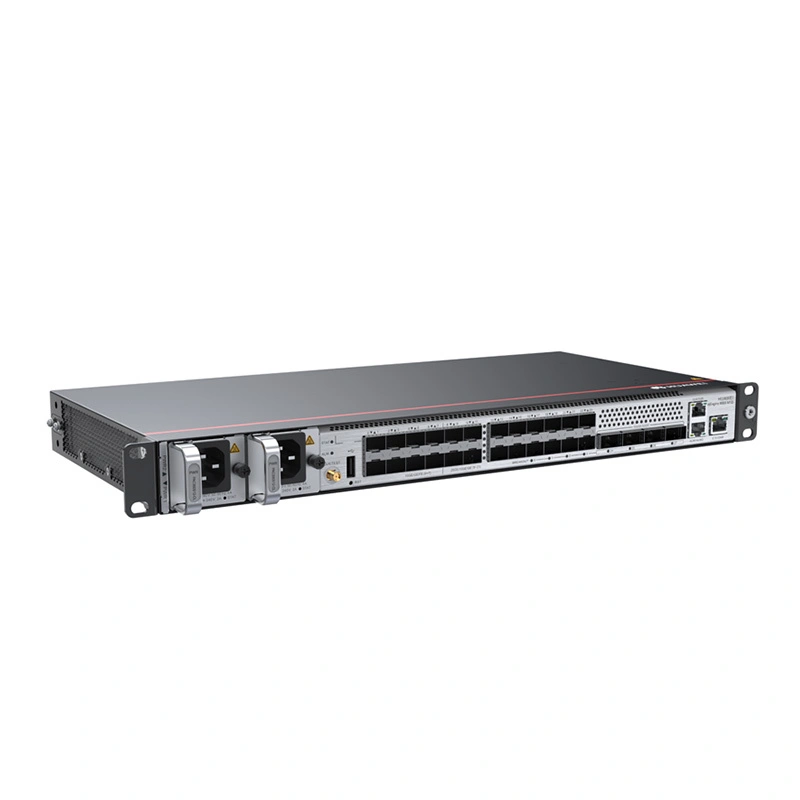
Huawei enterprise router NetEngine 8000 M1D core router with 4*100GE/50GE ports
● Model No.: NetEngine 8000 M1D
● size: 44.5*220*442mm
● Place of Origin: Guangdong, China
● Place of use: individual/enterprise cloud migration
● Warranty: 1 years
● MOQ: 1 pieces
Application scenarios
1.Edge aggregation of operational mall domain network: This is a very typical application scenario of M1D. It can serve as an edge routing device for operators, aggregating broadband and dedicated line business traffic from users such as enterprises, schools, and residential areas, and accessing the IP backbone network through upstream high-speed interfaces. It supports advanced technologies such as SRv6 and MPLS, and can efficiently carry various services such as 5G, home broadband, and enterprise dedicated lines, while providing strict business isolation
2.Large enterprise headquarters or park export gateway: For medium and large enterprises, government agencies, or universities, M1D can be deployed as a core export router at the network boundary. It can connect multiple operator networks, achieve traffic load sharing and link backup; Meanwhile, with its powerful NAT, firewall, and security filtering capabilities, it protects internal network security. Its high-performance forwarding capability can ensure the smooth experience of the whole company's access to the Internet and internal branch interconnection
3.Data center interconnection: With enterprise business going to the cloud, traffic between multiple data centers is surging. M1D, with its high-density 100GE/50GE ports, can serve as a data center interconnect device, providing a high bandwidth, low latency, and highly reliable data transmission channel. It supports overlay technologies such as VXLAN, enabling smooth migration and disaster recovery backup of cross data center business
4.Traditional TDM service bearer and migration: The M1D series platform has the ability to handle traditional TDM (such as E1) services, and can smoothly migrate TDM dedicated line services from 2G/3G base stations to IP/MPLS packet bearer networks. This solves the problem of how to utilize and protect existing TDM equipment investment while building a new IP network, achieving unified multi service carrying and reducing operation and maintenance costs
Core parameters
Data Center Interconnection (DCGW)
Enterprise level IGW deployment
Parameters
| Feature | Parameter Description |
| Product Positioning | High performance box core router, used for metropolitan area network core/aggregation, large enterprise/data center egress, IP backbone network edge, and as a single box supplement to cluster systems. |
| Core Value | Core in Cabinet ": Within a single cabinet space, it provides performance and features similar to cluster routers, achieving minimalist deployment and efficient operation and maintenance. |
| Form | Box type equipment. Supports front and rear ventilation and can be installed in a standard 19 inch cabinet. |
| Chassis Specifications | 5U high (approximately 460mm deep), compact design, saving space in the computer room. |
| System Architecture | Integrated distributed forwarding architecture. The Solar series self-developed chip, which is of the same generation as the NE8000 M1A, has been used to achieve fully distributed processing of control, switching, and forwarding in a box type device. |
| Switching Capacity | Several tens of Tbps level (e.g. ≥ 38.4 Tbps, specific values due to version updates). |
| Packet Forwarding Rate | Gigabit packet (Mpps) level (e.g. ≥ 14400 Mpps). |
| Master Control and Exchange | The main control, switching network, and fans are all redundant modules, but integrated into the chassis in the form of boards, supporting hot swapping. There is no independent concept of 'shelf'. |
| Power System | Redundant hot swappable power modules (usually 2+2 or 1+1 backup), supporting AC/HVDC. |
| Business Slot | Provide 8 business slots and support flexible installation of various types of high-speed business cards. |
| Interface Type and Density | Supporting a full range of high-speed interface cards, it is one of the strongest performance box routers in the industry: |
| High density 400GE interface board (core interconnect) | |
| 200GE/100GE/50GE interface board | |
| 800GE interface board (future oriented) | |
| FlexE (Flexible Ethernet) interface board | |
| 10GE/25GE/40GE interface board | |
| Core Features and Protocols | Equipped with advanced software features of the same generation as cluster routers: |
| SRv6: Native hard forwarding supports SRv6 BE/Policy, which is the key to building an intelligent cloud network. | |
| Network slicing: Implementing end-to-end hard/soft slicing through FlexE and SRv6 Policy. | |
| EVPN: Supports EVPN L2/L3, used in data centers and dedicated line scenarios. | |
| High performance QoS: Supports hierarchical HQQoS for precise management of massive business flows. | |
| Telemetry: Second level data collection for visual operation and maintenance. | |
| AI operation and maintenance: can be integrated with iMaster NCE to achieve intelligent tuning and fault prediction. | |
| Reliability | Carrier grade 99.999%, supporting critical component redundancy, hot patching NSR/NSF、 And TI-LFA based on SRv6 (50ms level fault rapid self-healing). |
| Typical Application Scenarios | 1. Metro core/aggregation: replaces traditional stacking of multiple devices and simplifies the architecture. |
| 2. Core of large enterprises/parks: serving as the high-speed exchange and strategy center for the entire network. | |
| 3. Data center exit/boundary (DCI edge): connects multiple data centers or connects to the backbone network. | |
| 4. IP backbone network/cloud backbone network edge (PE device): As a high-performance business access and forwarding node. | |
| 5. The core of low latency scenarios such as video live streaming/financial transactions: ensuring business continuity with high performance and SRv6 TI-LFA. |
Email: Lilicheng0510@163.com
We provide customers with various communication products at reasonable prices and high quality products and services
Flat/Rm P, 4/F, Lladro Centre, 72 Hoi Yuen Road, Kwun Tong, Hong Kong, China